Skip to content Skip to left sidebar Skip to footer

Outreach

Community Center Building Committee Upcoming Activities

We were pleased to have the opportunity to introduce ICON Architecture to the community during last week’s CCBC meeting.  ICON was selected, from among six firms who submitted proposals, to help us advance our work to the next stage.  ICON’s extensive municipal building portfolio, sustainable design expertise, reassuring approach to cost estimating and budgeting, strong municipal references, and impressive project team convinced us that they were the right choice.

Read More

Community Center Design Team Announcement

The Community Center Building Committee is pleased to announce that the Town of Lincoln has entered into a contract with ICON Architecture, for professional services associated with the development of plans for a community center within the Hartwell Campus on the Ballfield Road school campus.  ICON will assist the CCBC in reviewing and refining the program that has been developed for a new community center, and it will develop schematic design options at various cost levels so that town residents can make a fully informed choice on a preferred design and budget at a Special Town Meeting in November.

ICON Architecture is 50-person women-owned business based in Boston that specializes in institutional building types, building renewal, multi-family, and affordable housing.  The CCBC selected ICON after a careful screening and selection process, which included interviews of four firms (from among the six that submitted proposals), and an in-depth review of the two finalists.

Representatives of ICON will attend the CCBC meeting on Wednesday, March 8, to be held at 7:00 p.m. in the Donaldson Room at Town Offices, or over zoom for those who prefer to participate remotely:

Join Zoom Meeting

https://us06web.zoom.us/j/88568397168?pwd=QStkUEZad0JTNmFSaVNPQS85cGtJdz09

Meeting ID: 885 6839 7168

Passcode: 579905

How can community organizations use the new school facilities?

Community organizations cannot use the new school facilities during normal school hours (except in very specific circumstances, like elections) – 7:30 to 3:00 on Mondays, Tuesdays, Thursdays and Fridays, and 7:30 to 1:00 on Wednesdays, late August to late June.

At the end of each school day, some continuing educational activities have preferential use of the school facilities. These activities include Lincoln School drama, Lincoln School sports, and other after-school tutoring and counseling programs. Depending on availability, classroom and gym spaces are also used by the Lincoln After-School Music Program and the Lincoln Extended Day Program.

Community organizations, such as the Lincoln Gear Ticks (LEGO Robotics), are starting to make use in the evenings of the new public spaces in the school building. More organizations will find opportunities to use the facilities in the evenings, with the important constraint that the intensity of use cannot be such that it would interfere with the normal maintenance of the school (given that there is an intensive custodial effort at the end of each school day).

We have an evolving understanding of how community organizations will use the school facilities. We also understand that the new school building does not offer a solution to the facilities challenges of the Council on Aging & Human Services and of the Parks & Recreation Department, not least because the school building is unavailable for almost the entire time during which the COA&HS runs its programs.

What will happen to Bemis Hall if the COA&HS moves out?

We are happy to provide some information about potential uses of Bemis Hall in the future.   However, please note that determining the use of Bemis Hall after a community center is built is beyond the scope of the Community Center Building Committee.

We anticipate that the upstairs hall will continue to be used for performances, classes, dances, lectures, meetings, and private functions just as it is now.  In fact, this use can be expanded once the COA&HS no longer occupies the space during the day, providing opportunities for organizations to have space for playgroups, classes and lessons, afterschool activities, meetings, and more (Lincoln-CCPPDC-Report-07-12-18-digital (lincolntown.org) – page 21). The Town has received numerous requests in the past to use the upstairs space during the day for these purposes.

The basement is currently occupied by the Lincoln Girl Scouts, the Lincoln Minute Men, the Library Book Sale, and the Lincoln Historical Society. We expect that these organizations will continue to use the space they now have, with the possibility of expanding into some of the space that will no longer be used during the day by the COA&HS. The COA&HS has already received requests from renters for basement and first floor programming space during COA&HS hours.

The space that will be vacated by the COA&HS  includes the 450 square foot program room, and two small offices in the basement, and the first-floor space. Two ideas for using this for municipal space that have been discussed include programming space for the Library and space for all the Town’s land use offices and organizations. 

If space is leftover, Lincoln could follow the lead of other cities and towns that have buildings much like Bemis Hall and rent it to non-profit organizations, small professional firms, and others or use it for arts or other purposes.

One perfect example of this re-use is Bedford’s Old Town Hall, which is much like Bemis Hall in terms of size and configuration.  It has a large upstairs hall that is used for exactly the same purposes as the upstairs hall at Bemis is currently. The downstairs offices and other spaces are used by the Bedford Center for the Arts and Bedford Community Access Television. It is owned by the Town of Bedford but managed by a non-profit organization. Other towns with town halls that are no longer used town halls and are rented out or used for other purposes in a similar fashion are in Tyngsboro (rentals), Salem (art exhibits), Athol (Historical Society), Bedford, NH (rentals and community use), Easthampton (arts, maintained by non-profit), and Andover (private function rentals).

When will town residents have decisive input in the Community Center planning process?

November 30, 2022:
Vote at Special Town, to authorize the transfer of up to $325,000 from the Stabilization Fund so that the CCBC can develop Community Center design and budget options.

September 30, 2023:

The CCBC will present various design options at different cost levels for resident preferences and feedback.

December 2, 2023:
The CCBC will present comprehensive design and budget options at a Special Town Meeting, and town residents will select the preferred option.

March 23, 2024:
At Town Meeting and in a subsequent ballot vote, town residents will vote to authorize the financing for the construction of the Community Center, based on the design and budget selected in November. For approval, the bond vote requires a 2/3 majority at Town Meeting and a simple majority at the ballot.

What will the operating costs of the new Community Center be?

The short answer is that we can’t know the operating costs of a building that we haven’t designed yet.  However, we can specify some parameters which would help to narrow the possible answers to the question:

The Town already pays the operating costs of a set of buildings that house the Council on Aging & Human Services (COA&HS) and the Parks & Recreation Department (PRD), specifically Bemis Hall and two of the Hartwell Pods.  So the appropriate question is not what the operating costs of the Community Center will be, but how those costs will be different from the current costs.  

The Town will continue to pay operating costs for Bemis even if the COA&HS, moves out (though it is likely that those costs will diminish as the intensity of use diminishes, and the Town’s expenses are likely to be increasingly offset by rental income and fees from community organizations).  But most plans have at least two of the Hartwell Pods disappearing — demolished or integrated — with the construction of the Community Center, so the appropriate focus here is on the net change in operating costs for the Hartwell Pods versus the Community Center.

The Hartwell Pods are very inefficient buildings, while the Community Center would be a very efficient – probably net-zero – building, so there would be a large savings in utility costs.  That savings might be offset by an increase in custodial costs.  The Pods currently have part-time custodial support (carried on the school budget), while the Community Center would probably have a full-time custodian. (Additional personnel expenses, such as staffing for a reception desk, are very hard to model at this point, because we don’t know if those tasks will be necessary, or if they might be performed by volunteers or rotating staff or seniors working for tax abatements.) For planning purposes, it is reasonable to expect that any net change in operating expenses from a new Community Center – a decrease in utility costs offset by a possible increase in custodial costs — would not have a discernible impact on property tax bills. 

What is the recent history of official discussion of a Community Center in Lincoln – what questions have previous committees asked and what answers has Lincoln given to those questions?

In 2012, the Select Board appointed a Community Center Feasibility Committee to evaluate existing and future space needs of the Council on Aging & Human Services (COA&HS) and the Parks & Recreation Department (PRD). The Committee concluded that Bemis was not well-suited for use as a senior center, and that the Hartwell Pods, home to PRD, were long past their life expectancy. The Committee recommended that the Select Board lead a public process to assess the Town’s interest in a new community center and to study potential sites. 

In 2015, the Board appointed a Community Center Study Committee to determine the Town’s desire for a community center and to examine sites. The Committee concluded that COA&HS’s needs are acute and immediate, and that PRD’s needs are significant. After extensive and multiple opportunities for public participation and input were provided, the “overwhelming” choice for location, among five site alternatives, was the Hartwell Campus. 

In 2016, the Select Board and School Committee jointly appointed a Campus Master Planning Committee to determine whether the Ballfield Road Campus has the capacity to absorb additional uses, including a community center. The Committee concluded that there is no engineering or regulatory reason precluding a community center on the Ballfield Road campus. 

In 2018, the Community Center Preliminary Planning and Design Committee (CCPPDC), the most recent Community Center planning Committee, issued its report. CCPPDC advanced the process to the point that we now have two conceptual design options for a new Community Center in the Hartwell area of the Ballfield Road school campus. CCPPDC’s contributions include: further definition of the program; development of a range of site plans; preliminary design development for two building concepts; and more refined cost estimates. CCPPDC’s work culminated in a Special Town Meeting presentation on June 9, 2018. In the end, both CCPPDC and Town Meeting felt that both conceptual designs that were presented (i.e., a new building concept that was titled “Central Secondary Green”, and a plan to repurpose the pods titled “Infill of Pods”) were equally worthy of further consideration. 

Why would the Community Center be on the Hartwell campus?

If Lincoln decides to build a Community Center, that Center is expected to be on the Hartwell Campus, adjoining the Lincoln Public Schools.  There are several reasons for this determination, but it is worth highlighting two of them here:

First, there is a set of practical reasons, having to do with the inclusion of the Parks & Recreation Department (PRD) in the Community Center.  It is much more efficient to build a Center that houses both the PRD and the Lincoln Council on Aging & Human Services, because almost every space in the shared building would be a shared space.  And because it is very important for the PRD to remain close to the Lincoln Schools, so that the schoolchildren have easy access to the PRD after-school programming, it makes sense to locate the Community Center where there is space on the school campus.

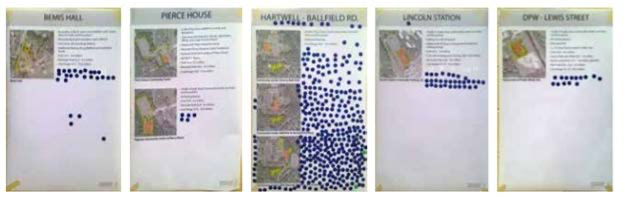
Second, the Community Center is expected to be at Hartwell because that is the clearly stated preference of the residents of Lincoln.  For instance, at the State of the Town Meeting on November 15, 2014, 350 residents expressed their preferences for a Community Center site, with a very large majority choosing the Hartwell site, among five options.  The Community Center Study Committee therefore concluded:

The overwhelmingly favored choice for a location by Lincoln residents is at the Hartwell complex, where it would help to anchor an entire “community campus” consisting of the Community Center, the Lincoln Public Schools, the Town playgrounds and playing fields, and the Codman Pool. 

page10image8464864

Public feedback on the preferred site for the Community Center (State of the Town, November, 2014)

We welcome all input and questions from town residents, and will make every effort to solicit, hear, and address the priorities, values and concerns of Lincoln residents concerning a new Community Center.

Why would Lincoln build a new Community Center rather than use existing buildings?

Lincoln has known for a long time that Bemis Hall is not an appropriate building for the Council on Aging & Human Services (COA&HS):

  • A 2008 needs assessment “determined that Bemis Hall not be the long-term home for the COA.”  (Since that assessment, the Lincoln senior population has increased by 50%.)
  • In 2012, the Community Center Feasibility Committee (CCFC) concluded about Bemis Hall that it was “not built to be a modern senior center with myriad programs and services.”
  • The CCFC reiterated in a 2013 follow-up that Bemis is “not well suited for a senior center.”
  • In February, 2015, the Community Center Study Committee (CCSC) reported that, “compared with neighboring towns, the quality, size and condition of Lincoln’s COA facility is vastly inferior, and its physical deficits limit the programs and services which can be offered to elders.”
  • The CCSC provided additional detail about the shortcomings of Bemis Hall: “the interior space does not allow for congregate meals, a significant drop-in area, adequate and confidential office space for staff and volunteers, private restroom locations, or all programming needed to meet the needs of Lincoln’s growing population of older adults.”
  • In 2018, the Community Center Preliminary Planning & Development Committee wrote more broadly that:

Doing nothing to provide adequate facilities for the COA, PRD [Parks & Recreation Department], and community organizations is not an option.  The physical plants of both Bemis Hall and the pods continue to age, and it makes no sense for the Town to continue to expend scarce tax dollars to fix up, patch up and make do with facilities that do not suit their purpose.  Just as important, every year that these departments and organizations are not able to provide the range of activities and programs that are standard in other towns and are located in buildings that discourage residents from making use of their services means that opportunities to improve residents’ quality of life are lost.

In 2012, the CCFC studied other town facilities, asking whether any existing building could serve as a better home for the COA&HS than Bemis Hall.  The CCFC concluded that no other existing building could serve the needs of the COA.  Pierce House, for instance, has two assets – a good location and plentiful parking – but fails on every other criterion as a potential home for the COA&HS: the spaces in the existing building don’t match the programmatic needs, the possibilities for extensive expansion or reconfiguration are very limited, and Pierce House couldn’t accommodate the Parks & Recreation Department (PRD).  

For over 10 years, Town Committees have studied and evaluated options for a Community Center., and have consistently concluded that continuing to offer activities and services under the existing conditions of Bemis Hall and the pods is no longer feasible or acceptable.  Other existing town facilities do not offer a solution to the problem.  If Lincoln wants a Community Center, then building a new one is the most efficient use of town resources.

We welcome all input and questions from town residents, and will make every effort to solicit, hear, and address the priorities, values and concerns of Lincoln residents concerning a new Community Center.

What is the CCBC – which stakeholders are represented, what are its tasks, and how can others participate?

We encourage questions, and have been asked for information on the Community Center Building Committee (CCBC), including its role and responsibilities.

In March, 2022, the Lincoln Annual Town Meeting voted with near unanimity to restart the Community Center planning and design process, and to request that the Select Board appoint a building committee.  (The specific motion is appended below.)

So the Select Board appointed a Community Center Building Committee (CCBC), which started work at the beginning of June.  (The membership list is appended below.). The initial task of the CCBC has been to prepare an initial funding proposal – if the Town approves this proposal, for up to $325,000, at the Special Town Meeting on November 30, then the CCBC will hire an Owner’s Project Manager and a project architect to prepare schematic designs.  The Town will have the opportunity to select its preferred design, and then it will have the additional opportunity to vote on funding for the construction of the Community Center.  (The specific charge of the CCBC is appended below.)

The CCBC will be building on the work of a series of town committees that have developed the concept and parameters for a Community Center in Lincoln.  The CCBC will refine the concept, incorporating lessons from COVID and from the school building process, continuing the search for cost savings, and incorporating input about programmatic priorities.

The CCBC and its subcommittees hold open meetings and invite public participation.  The schedule of those meetings is available on the town website, and the CCBC will use other forums to inform residents about upcoming meetings and their agendas.  We particularly urge residents to look for information on the CCBC website (https://lincolncommunitycenter.com/).  There will be a high-level overview of Community Center planning at the State of the Town Meeting, on Monday, November 14.  Then there will be an extensive presentation and opportunity for discussion at the Special Town Meeting on Wednesday, November 30, before the vote on funding for the next stage of the planning process.

We hope that this information is helpful.  We are happy to answer all questions.

Members of the CCBC:

AT-LARGE MEMBERS: Sarah Chester, Chair; Timothy Christenfeld; Alison Taunton-Rigby; Krystal Wood


BOARD REPRESENTATIVES: Jonathan Dwyer, Select Board; Margit Griffith, Parks & Recreation Committee; Adam Hogue, School Committee; Ellen Meyer-Shorb, Finance Committee; Dilla Tingley, Council on Aging & Human Services

BOARD LIAISONS: Lynn Delisi, Planning Board; Andrew Glass, Historical Commission; Steve Gladstone, Water Department; Roy Harvey, Green Energy Committee; Indrani Kharbanda, Library Board of Trustees; David Levington, Friends of the Lincoln Library, Peter von Mertens, Conservation Commission & Friends of the Council on Aging

EX-OFFICIO MEMBERS: Abigail Butt, COA & Human Services Director; Jessica Downing, Parks and Recreation Director; Timothy Higgins, Town Administrator; Brandon Kelly, Facilities Director; Daniel Pereira, Asst. Town Administrator

Motion approved at Town Meeting, March, 2022:

That the Town provide the Select Board with a sense of the meeting as to restarting the Community Center planning and design process, and, if such sense of the meeting is in the affirmative, to request that the Board appoint a building committee, by whatever title, to review the results of previous planning efforts and to present its findings in an expedited manner so that a request for funds for planning and design services could appear on the warrant for a fall 2022 Special Town Meeting. 

The official tasks of the CCBC:

  1. Review and become familiar with previous plans and existing materials. 
  2. Create a plan for gathering stakeholder input, and for regular communication with, and input from relevant Town boards, committees, and the community. As appropriate, this will require collaboration with the School Committee and/or Building Committee. 
  3. Work with the Town Administrator to ensure that the process for contracting with an Owners’ Project Manager (OPM) and project Architect are carried out in compliance with state law and with an emphasis on diversity. 
  4. Review the program again, taking care to consider how COVID experiences and lessons might inform programs, interior space layout, outdoor amenities, and design, and the role the new and renovated school spaces might play. 
  5. Review the two CCBC design concepts and schematics to identify opportunities for improvement, including potential cost savings that may be achieved through re-evaluating the project scope or by other means. Develop the schematic designs to the extent required to ensure reliable cost estimating.
  6.  Lead the public engagement process which will culminate in a Town Meeting vote to select a preferred design concept and budget. 
  7. Once funds are approved, oversee the process for finalizing the design, bidding, contract award and construction, including repaving of Ballfield Road and any new paths serving the Community Center. Lead public engagement process as necessary for input into value engineering.